
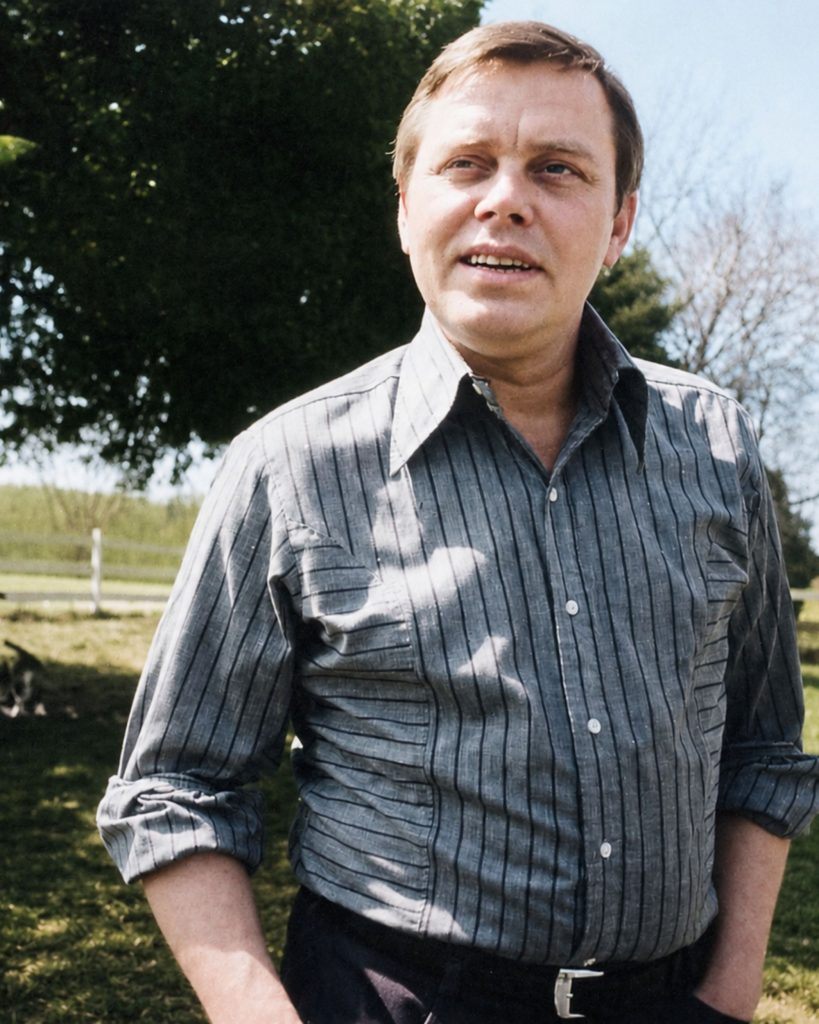
A VIRGINIA DJ WROTE ONE SONG FOR ANOTHER SINGER. A YEAR LATER, TOM T. HALL LEFT THE RADIO BOOTH AND WENT TO NASHVILLE WITH NOTHING BUT STORIES.
Before Tom T. Hall became country music’s “Storyteller,” he was working a radio shift in Virginia.
He had grown up in Olive Hill, Kentucky.
A boy writing songs.
Playing bluegrass wherever somebody would let him.
Then came the Army.
Germany.
Armed Forces Radio.
And eventually a job as a disc jockey back home.
The job gave him a microphone, a stack of records, and a front-row seat to the people country music was supposed to be about.
The Radio Booth Was Full Of Other People’s Lives
Truck drivers calling after dark.
Farmers listening before dawn.
Women requesting songs they could not explain to anyone at home.
Hall was playing records.
But he was listening too.
He began writing songs that did not sound like big Nashville ideas.
They sounded like people.
A man with a problem.
A woman with a secret.
A kitchen with a radio in the corner.
A lonely voice calling after midnight.
Tom learned something important in that booth.
People would tell you almost anything if you stayed quiet long enough.
Then One Song Got Out Of Virginia
A Nashville publisher named Jimmy Key heard some of Hall’s material.
Key took one song, “D.J. for a Day,” and gave it to Grand Ole Opry singer Jimmy C. Newman.
Newman recorded it in 1963.
The song became a Top 10 country hit.
For Tom T. Hall, that one record changed the direction of everything.
He had written a song from behind a radio microphone.
Now country radio was sending it back across America in somebody else’s voice.
The Next Year, He Left
In 1964, Hall left Virginia and moved to Nashville.
He went to work for Newkeys Music.
The pay was small.
Around fifty dollars a week.
The work was constant.
He was expected to write every day.
Sometimes several songs in a day.
The radio booth was gone.
Now he was sitting in Nashville, trying to turn every person he had watched, every call he had heard, every story he had carried out of Kentucky and Virginia into something another singer could take to the charts.
Then The Stories Started Finding Their Voices
Dave Dudley recorded “Mad.”
Johnnie Wright took “Hello Vietnam” to No. 1.
Then came “Harper Valley P.T.A.” for Jeannie C. Riley.
“The Year That Clayton Delaney Died.”
“Homecoming.”
“Old Dogs, Children and Watermelon Wine.”
Tom T. Hall did not write songs like a man trying to impress a room full of executives.
He wrote them like a man who had sat near enough to ordinary people to know that their lives already had drama in them.
They only needed someone to notice.
What Tom T. Hall Really Took To Nashville
The deepest part of this story is not only that one Top 10 song got Tom T. Hall to Nashville.
It is what he carried with him.
A Kentucky childhood.
A bluegrass guitar.
An Army radio station.
A Virginia booth.
Late-night callers.
Early-morning farmers.
Fifty dollars a week.
And a habit of listening harder than most people talk.
Tom T. Hall did not go to Nashville with a polished image or a giant voice.
He went with stories.
And country music finally found the man who knew how to make ordinary lives impossible to forget.
Video